Русский

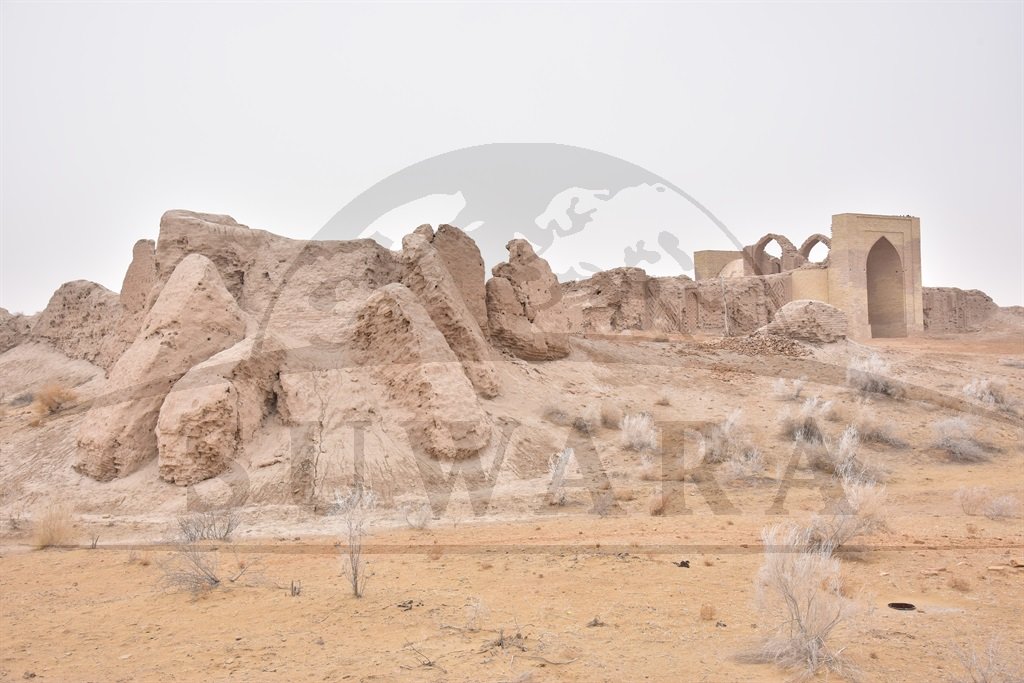
Dayakhatyn, also known as Baykhatyn, is a medieval caravanserai located along the ancient trade route on the banks of the Amu Darya River from Amul to Khwarazm. It is situated at a distance of 173 km on the Turkmenabat-Dargan-Ata highway, near the Khanabad railway station.
The local name of the monument, Baykhatyn, is associated with a legend that tells the story of a wealthy man (bay) who suspected his wife of infidelity. Offended by the perceived betrayal, he left his home dressed as a beggar dervish. His wife, Baykhatyn, waited for his return for many years. To ease his hardships in the desert, she built a large and beautiful caravanserai. Bricks for its construction were made in Merv and passed hand to hand along a living chain to the construction site. Among the workers was her husband, who returned to his homeland after his wanderings. Baykhatyn recognized her husband but remained unrecognized herself, hidden beneath a chador. After the completion of the construction, she organized a feast and indirectly revealed the truth to her husband. The legend concludes with the reconciliation of the spouses.
In written sources, this section of the route is mentioned to have a rabat, the caravanserai of Tahiria. According to medieval authors, including Yakut, the name of the caravanserai is associated with Tahir ibn al-Husayn, the ruler of Khurasan in the 9th century. The same author notes that Tahiria marked the beginning of the Khwarazm region from the side of Amul. Hamdallah Mustawfi also mentions Tahiria when describing the trade route from Merv to Khwarazm.
Today, Dayakhatyn is a vast (112x125m) ruin made of raw brick. Once a fortress, it was fortified with round and rectangular corner towers. The caravanserai itself is square in plan, with sides measuring 53x53m. It has an open courtyard in the middle, measuring 30x30m, surrounded by a covered vaulted gallery and numerous large and small rooms located on all four sides of the courtyard. The construction material used was high-quality, well-fired bricks of various sizes, skillfully used in the main walls, arches, domes, and vaults.
Several religious centers housed numerous groups of dervishes, including the Khanakas of Meikhen (modern-day Meanakakhkinsky District), Seravi (in Nisa), and others. During the post-Mongol period, information about such Khanakas is practically absent. However, dervishes in the Turkmen environment, who mostly appeared from neighboring regions in the late Middle Ages and modern times, have always been highly respected. An illustration of this can be found in the description of A. Vambery's journey through Western Turkmenistan in 1863 when impoverished elderly people gladly slaughtered their only goat to treat the dervish-hajjis.