Русский

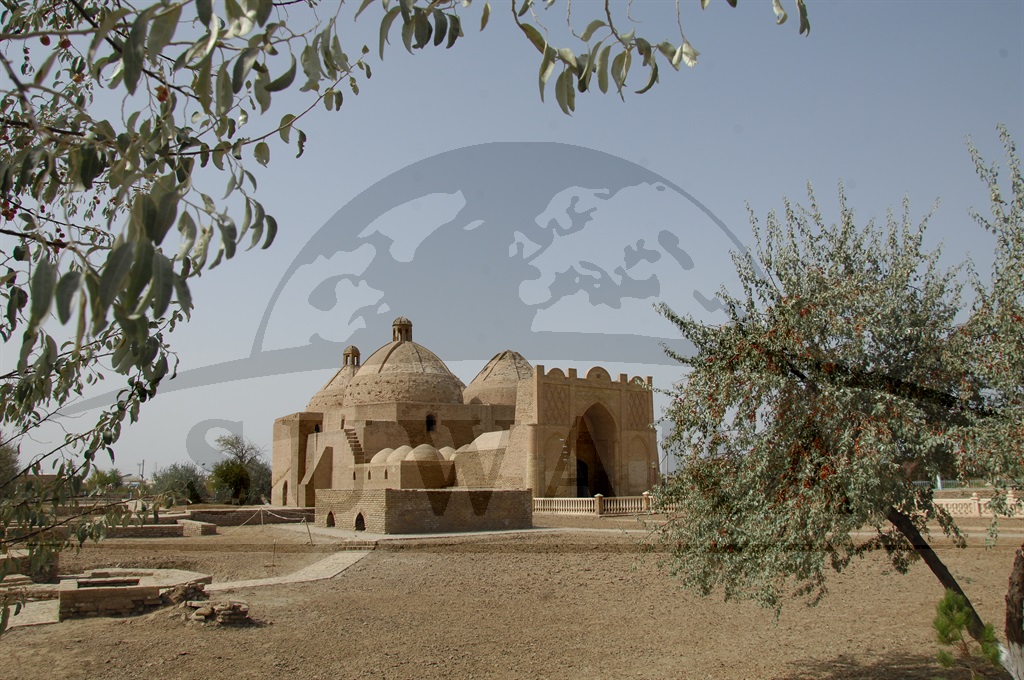
Сomplicated in its composition, the mausoleum of Astana-baba, located in the Kerki district, is completely unique. It is locally known as the Mazar of Astana-baba, as well as the mausoleum of the brothers Zeyd-Ali and Zuveyd-Ali and their wives, Kyzlyar-bibi. There are several legends surrounding this Mazar. In some, it is referred to as the mausoleum of Hazrat Shahi-Maydan ("Holy from the Shah's Square"), while in others, it is believed to have been built for Hazrat ibn-Ali Nur-ogly's daughter.
Four hundred years ago, according to the legend, the only daughter of the ruler of Balkh, ibn-Ali Nur-ogly, named Zuyveida, unexpectedly passed away after being married off to a local governor. Grief-stricken, her father ordered the construction of a mausoleum for her and brought the best craftsmen from Merv and Samarkand. However, after its completion, the mausoleum collapsed. The same fate befell the reconstructed building three times. Nur-ogly became desperate until an old man appeared to him in a dream and advised him to build the mausoleum using clay and water brought from Mecca. The desolate father followed the advice. The clay was mixed with the soil brought from Mecca, and the water from Mecca was poured into a well, which was used for construction purposes. Thus, the mausoleum was completed, and after Nur-ogly's death, his body was also buried in a chamber adjacent to his daughter's burial place.
The mausoleum of Astana-baba stands out with its extraordinary grouping of four domed structures, united into a single system with entrance structures.
The existing ensemble of the mausoleum consists of several parts: dromos (an open corridor), courtyard, portal, covered corridor, four-pillared hall, mosque, the burial place of Zeyd-Ali and Zuveyd-Ali, divan-khana, and a narrow corridor connecting to the mausoleum of Kyzlyar-bibi.
The mosque is the oldest part of the ensemble and can be dated back to the 12th century. Its walls are made of fired bricks measuring 24 x 24 x 4.5 cm. The divan-khana appeared simultaneously with the mosque.
The mausoleum of Kyzlyar-bibi is a later addition to the ensemble, constructed using bricks of different sizes, possibly reused (possibly from the 19th century). The portal belongs to the 19th century, and above its door, various carved terracotta tiles are embedded (12th-14th centuries).
It has been established that this unique ensemble underwent multiple repairs and renovations between the 13th and 19th centuries.